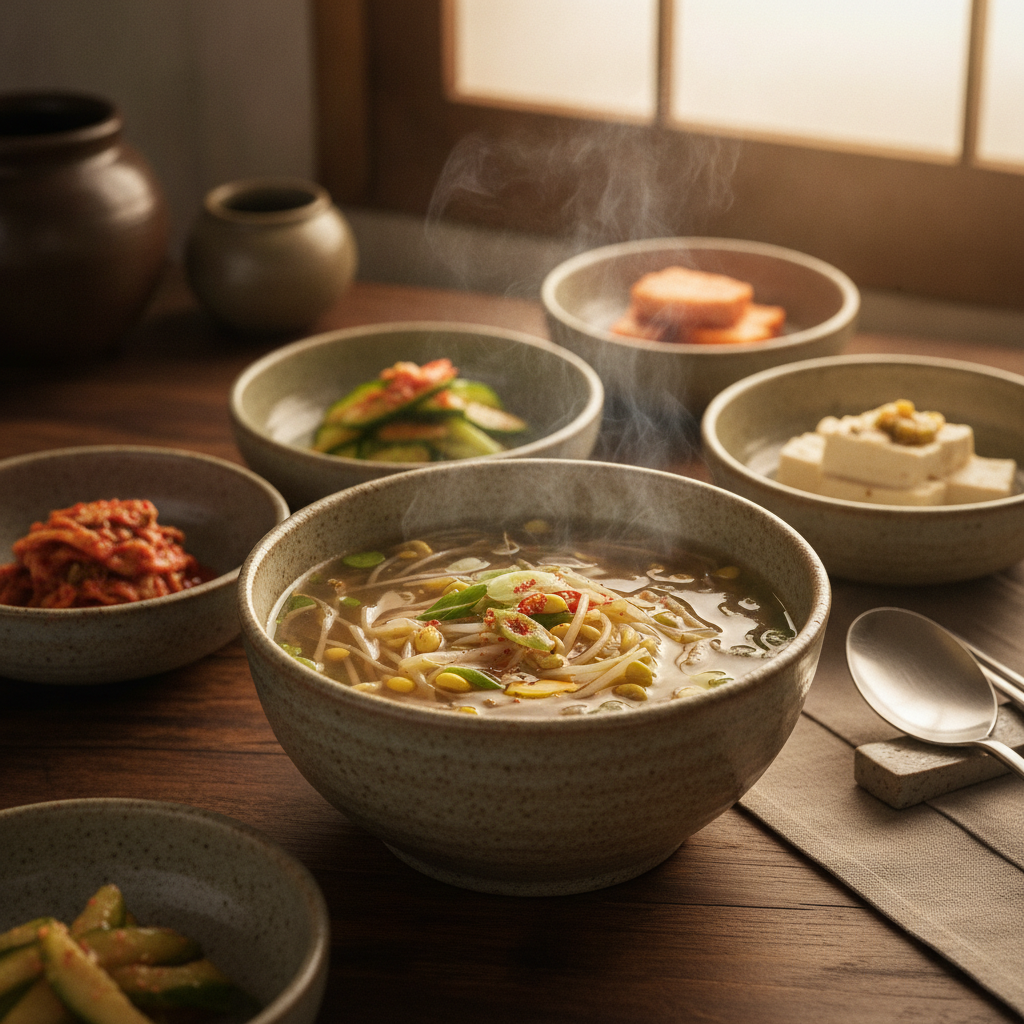
Clear and Refreshing Hangover Cure, Korean Soul Food: Kongnamul-guk (Soybean Sprout Soup)
1. History and Origin of Kongnamul-guk
Kongnamul-guk holds a meaning beyond a simple dish on the Korean table. Its origin dates back to the Three Kingdoms period, with records in the "Samguk Sagi" documenting soybean sprout cultivation, testifying to its long history. Especially during times of drought or famine when food was scarce, soybean sprouts played a crucial role as a relief crop, allowing many people to be fed with just a few soybeans, providing highly nutritious vegetables. Soybean sprouts, which germinate protein-rich soybeans to produce various nutrients like vitamin C, were an important ingredient for maintaining the health of the common people at that time.
During the Goryeo Dynasty, "Goryeodogyeong" records that soybean sprouts, referred to as 'Hwangdu-a (黃豆芽)', were enjoyed even in the royal court. By the Joseon Dynasty, cultivation methods and recipes for soybean sprouts were detailed in various texts such as "Sallim Gyeongje" and "Gyuhap Chongseo". Kongnamul-guk, in particular, was a humble dish that soothed the sorrows of commoners, and its excellent hangover-curing properties led it to become synonymous with 'haejangguk' (hangover soup). "Donguibogam" records that soybean sprouts have detoxifying and fever-reducing effects, indicating that Kongnamul-guk held the meaning of a medicinal diet (yakseon) from ancient times, not just a simple soup.
During the "boritgogae" (barley hump) period after the Korean War, inexpensive and nutritious Kongnamul-guk provided a hearty meal that alleviated the hunger of the common people. To this day, it remains a beloved national dish on our dining tables. A bowl of Kongnamul-guk encapsulates the wisdom and history of our people, offering warm comfort and satisfying fullness, truly a soul food for Koreans.
2. Authentic Recipe
Ingredients (Serves 4)
- Soybean sprouts: 300g
- Dried anchovy and kelp broth: 1.5L (15g dried anchovies for broth, 1 10x10cm piece of kelp, 1.8L water)
- Green onion: 1/2 stalk
- Cheongyang chili pepper: 1 (optional)
- Minced garlic: 1 tablespoon
- Salted shrimp (saeujeot): 1.5 tablespoons (or Korean soy sauce for soup 1.5 tablespoons)
- Salt: to taste
- Water: 1.8L (for broth)
Instructions
- Prepare the broth: In a pot, add 1.8L of water, dried anchovies, and kelp. Bring to a boil. Once boiling, remove the kelp first. Continue to boil the anchovies over medium heat for about 10 minutes to create a rich broth. Remove the anchovies and prepare 1.5L of clear broth.
- Prepare soybean sprouts: Wash the soybean sprouts thoroughly, being careful not to damage the heads or tails. (It's best to keep the tails as they contain a lot of asparagine.)
- Prepare other ingredients: Slice the green onion diagonally. Slice the Cheongyang chili pepper thinly, if using.
- Boil the soup: Pour the prepared anchovy and kelp broth into a deep pot and bring to a boil over high heat. Once boiling, add the prepared soybean sprouts, cover the pot, and cook for 3-5 minutes. (To prevent the peculiar smell of soybean sprouts, it's crucial to either keep the lid closed from the beginning until fully cooked or keep it open throughout. Opening it midway can cause a strong odor.)
- Seasoning: When the soybean sprouts are translucent and cooked, add minced garlic and salted shrimp (or Korean soy sauce for soup) to season. Adjust the final seasoning with salt to your preference.
- Finishing touches: Finally, add the green onion and Cheongyang chili pepper (if using) and boil for another moment before turning off the heat.
- Serving: Serve warm in bowls.
3. Characteristics of the Flavor
A bowl of carefully prepared Kongnamul-guk offers a deeper sense of comfort and satisfaction than any elaborate dish. The first thing that tickles the nose is the clear and refreshing aroma of dried anchovy and kelp broth. The deep oceanic flavor gently spreads, stimulating the salivary glands. Then, the savory and fresh scent of boiling soybean sprouts is added, creating a complex harmony of aromas, not just a simple broth.
Taking a spoonful, an exclamation of "refreshing" naturally escapes. The initial taste is clear and clean, with a subtle yet exquisite umami from the anchovy broth. Following this, the crunchy texture of the soybean sprouts provides a refreshing sensation in the mouth, and as you chew, the inherent savory and slightly sweet flavor of the sprouts adds depth. The pungency of minced garlic and the salty umami of salted shrimp infuse into the broth, completing a well-balanced flavor. If Cheongyang chili is added, the spiciness provides an exhilarating kick that feels like it's clearing the system.
Kongnamul-guk is characterized by its deep yet non-irritating flavor, leaving you feeling comfortable and refreshed after eating. The warm sensation spreads throughout the body, as if revitalizing a tired body and mind. Despite being made with humble ingredients, its depth of flavor and satisfaction possess a magical charm that captivates even gourmets. Especially when enjoyed as a hangover soup, the refreshing coolness is maximized, proving why it has become synonymous with the 'hangover cure' beloved by Koreans.
4. Cooking Tips and Secrets
Unveiling Professional Secrets!
- The Importance of Broth: 90% of Kongnamul-guk's taste depends on the broth. A deep broth made by thoroughly simmering good quality dried anchovies and kelp should be the foundation. Anchovies should have their guts removed to prevent bitterness, and kelp should not be boiled for too long as it can release a slimy substance that clouds the broth, so it's best to remove it as soon as it boils. Using rice water (ssal-tteumul) for the broth can help eliminate the raw smell of soybean sprouts and create a more savory and deep flavor.
- Eliminating Soybean Sprout Odor: Soybean sprouts can easily develop an unpleasant odor during cooking. To prevent this, you must choose one of two methods: either keep the lid closed from the beginning until they are fully cooked without opening it, or keep the lid entirely open from the start to allow steam to escape. Opening the lid midway can cause the raw smell to permeate the sprouts, ruining the taste.
- Seasoning: Seasoning Kongnamul-guk with salted shrimp (saeujeot) is the traditional method. Salted shrimp pairs well with soybean sprouts, adding a refreshing and savory umami while keeping the broth clear. If salted shrimp is unavailable, you can use Korean soy sauce for soup, but be mindful that it can darken the color of the soup, so mixing it with a bit of salt is a good approach. It's best to season at the very end.
- Cooking Soybean Sprouts: If soybean sprouts are boiled for too long, they become mushy and lose their crunchy texture. It's crucial to cook them just until they become transparent and slightly tender. Typically, 3-5 minutes in boiling water is sufficient.
- Adding Freshness: Thinly sliced radish added to the broth or cooked alongside the soybean sprouts can impart an even more refreshing and subtly sweet flavor. Adding Cheongyang chili peppers or red chili peppers enhances the spiciness, doubling its appeal as a hangover soup.
5. Variation Recipes
1. Kimchi Kongnamul-guk (Spicy Hangover Version)
This is a spicy and robust hangover version of the classic Kongnamul-guk, with the addition of kimchi. After making the broth, before adding the soybean sprouts, lightly stir-fry finely chopped aged kimchi (1/4 head) in a little sesame oil, then pour in the broth and bring to a boil. You can also add a bit of kimchi juice. After adding the soybean sprouts and cooking, season with 1 tablespoon of gochugaru (chili powder), minced garlic, and Korean soy sauce for soup. Adding pork or tuna can make it heartier and deeper in flavor.
2. Hwangtae Kongnamul-guk (Deep Umami Version)
Hwangtae (dried pollock) is an ingredient known for its deep and refreshing flavor, and when combined with Kongnamul-guk, it offers excellent hangover relief. Instead of anchovy broth, make a broth with hwangtae heads or dried hwangtae fillets, or stir-fry shredded hwangtae (50g) in sesame oil before adding the broth and boiling. The savory richness of hwangtae and the refreshing quality of soybean sprouts create an even deeper and cleaner taste. Adding beaten egg can also add a smooth texture.
3. Kongnamul Bukeo-guk (Simple Hangover Version)
This is a convenient hangover soup version for busy mornings. If preparing anchovy-kelp broth is too much trouble, you can use store-bought beef bone broth or instant broth packets. Add soybean sprouts and boil, then add shredded dried pollock (30g) that has been soaked in water and shredded. Season with minced garlic and salted shrimp. Finish by adding a beaten egg and a drop of sesame oil to complete a hearty and delicious hangover soup in a short amount of time.
4. Kongnamul Ttukbaegi Haejangguk (Hearty Meal Version)
This version involves cooking Kongnamul-guk in a ttukbaegi (earthenware pot) and enjoying it piping hot. For an even richer flavor, add cooked rice to the boiling Kongnamul-guk, crack an egg yolk on top, and sprinkle with shredded nori or sesame seeds. You can also add sundae (Korean blood sausage) or offal to enjoy it like Jeonju-style Kongnamul Gukbap. The ttukbaegi keeps the soup warm for a