
Tradition: A Sweet Gong Connecting Hearts
Dorayaki is more than just a dessert; it holds deep cultural significance, accompanying the Japanese people through their daily lives and special moments. Its name, 'dora (銅鑼),' means gong, and the sight of sweet red bean paste sandwiched between these gong-shaped pancakes seems to connect humble yet steadfast hearts. In Japan, red beans have long been believed to ward off evil spirits and bring good fortune. Therefore, there's a deep-rooted tradition of gifting dorayaki on auspicious occasions or to express gratitude and comfort. On New Year's Day, sharing dorayaki with family after visiting a shrine becomes a simple ritual to wish for a peaceful year. Moreover, dorayaki accompanying a cup of tea with a long-unseen friend can be a warm medium for reminiscing about the past and sharing the present. Whether as a snack for children returning home from school or a piece of warm comfort offered to someone tired from work, dorayaki has always been there. Without any lavish packaging or complex preparation, a single piece of dorayaki possesses the warm power to connect people and soothe hearts. The softness and sweetness felt when biting into dorayaki transcend mere taste satisfaction, symbolizing the humble happiness and serenity deeply embedded in Japanese life. This resonates with Japan's 'wabi-sabi' aesthetic, where beauty is found in simplicity rather than grandeur, and perfection is felt within imperfection. This aesthetic value is fully encapsulated in dorayaki's mild yet profound taste. Even on ordinary days, enjoying dorayaki with a cup of tea becomes a precious moment for introspection and savoring simple joys. The Japanese sentiment and tradition layered within its sweetness make dorayaki even more special.
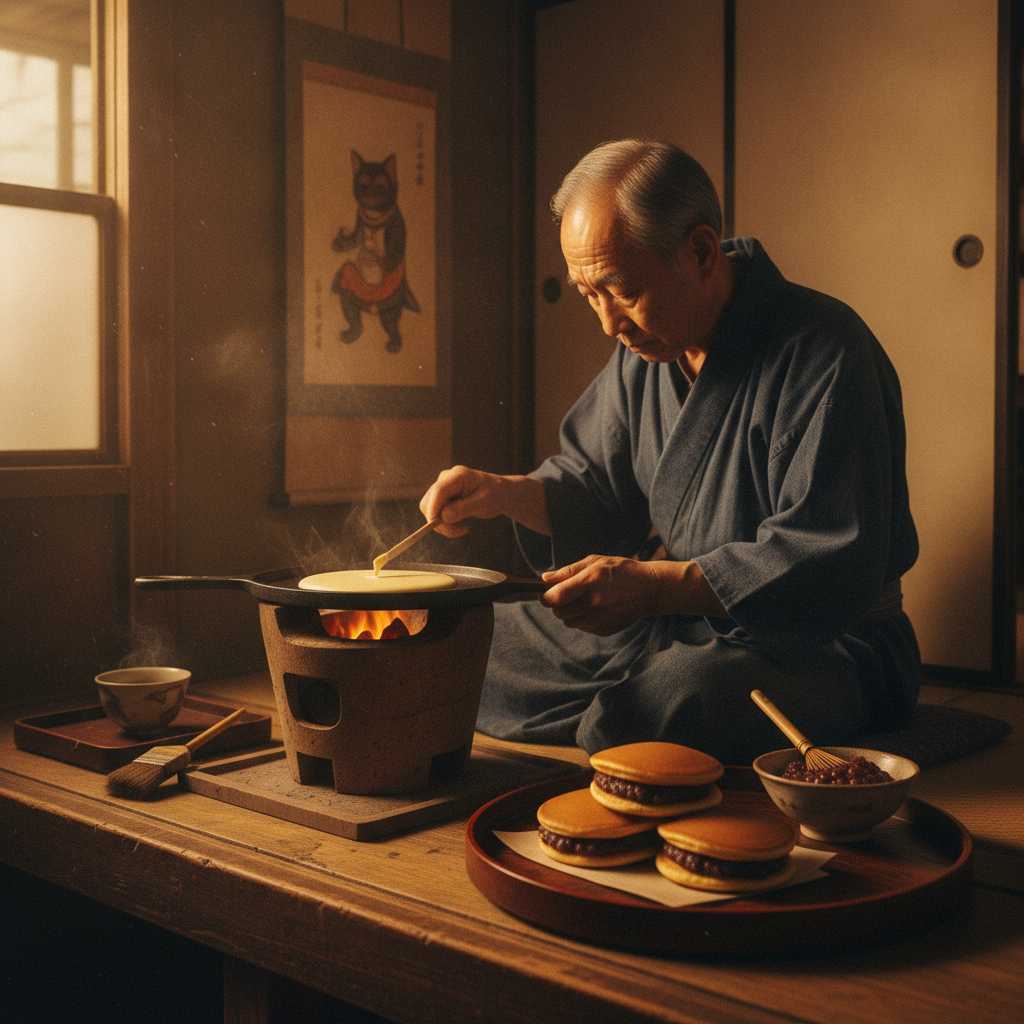
History: A Sweet Origin Born from Legend
While several accounts trace the precise origins of dorayaki, the most famous legend involves the Japanese hero Minamoto no Yoshitsune. The story goes that in the late 12th century, when Minamoto no Yoshitsune was being pursued by enemies and sought refuge in a farmhouse, a farmer used a gong (dora) as a frying pan to bake flour dough and served it to Yoshitsune. This tale is widely believed to be the beginning of dorayaki. While largely legendary, it's an intriguing story suggesting that the name dorayaki originated from the gong. Another theory suggests that around the 16th century, when Western confections like Castella cake were introduced to Japan from Portugal, Japanese-style breads and sweets began to emerge, and dorayaki's form gradually developed during this process. Early dorayaki is presumed not to have been in the sandwich form we know today. It was likely a single thin pancake topped with red bean paste. The sandwich-style dorayaki, with red bean paste sandwiched between two pancakes, appears to have emerged in the late Edo period or early Meiji era. This likely reflects the influence of Western sandwiches, and it was from this point that dorayaki began to establish itself as a popular snack. Particularly in the late 19th century, with the introduction of Western confectionery techniques to Japan, dorayaki's production methods gradually standardized, allowing for mass production. Then, in the mid-20th century, dorayaki gained global fame when it appeared as the favorite food of Doraemon, the protagonist of the beloved Japanese manga 'Doraemon.' Doraemon's boundless affection for dorayaki, often exclaiming, "I can do anything if I have dorayaki!", instilled a friendly image of dorayaki in many people. Thus, dorayaki has accompanied the lives of Japanese people for a long time, evolving and being cherished as a sweet legacy through legends and history.
Preparation: Softness Forged with Time and Care
While dorayaki may appear simple, achieving its soft texture and deep flavor requires delicate preparation and skilled techniques. The essence of traditional dorayaki lies in its 'castella-style batter' and 'handmade red bean paste.' First, the batter is primarily made from flour, eggs, sugar, honey, mirin, and sodium bicarbonate (baking soda). Honey and mirin, in particular, play crucial roles in adding a unique moistness, subtle sweetness, and sheen to the batter. These ingredients are gently mixed together, but it's important not to overmix, as this can develop gluten and make the batter tough; a moderate consistency is key. After preparing the batter, it's not immediately baked but allowed to rest for about 30 minutes to an hour. This resting period allows the ingredients in the batter to meld well and stabilizes the gluten, resulting in a softer, moister pancake. The rested batter is ladled onto a cast iron pan or special griddle heated to a consistent temperature and cooked into round shapes. Precise heat control is vital here: too high, and the outside will burn while the inside remains raw or the color becomes too dark; too low, and it won't rise sufficiently. When expertly baked by an artisan, each pancake develops a golden-brown surface and a fluffy, soft interior. The other key to dorayaki's flavor, the red bean paste, is made using carefully selected adzuki beans. After washing and soaking the beans sufficiently, they are boiled. It's common practice to discard the first batch of boiled water to remove the beans' characteristic astringency. The softly boiled beans are then simmered with sugar and a small amount of salt over low heat until reduced. There are two main types of red bean paste: 'tsubuan' (粒餡), which retains the bean texture, and 'koshian' (漉し餡), which is finely ground. Tsubuan is typically used in dorayaki to allow enjoyment of the beans' texture. The amount of sugar is a crucial factor in controlling sweetness, and salt enhances the sweetness. The finished red bean paste is cooled before use, and dorayaki is completed by generously sandwiching the paste between two baked pancakes. All these processes involve not just technique but the artisan's dedication, stemming
Looking for a place nearby? Search “도라야키” on Naver Map.