
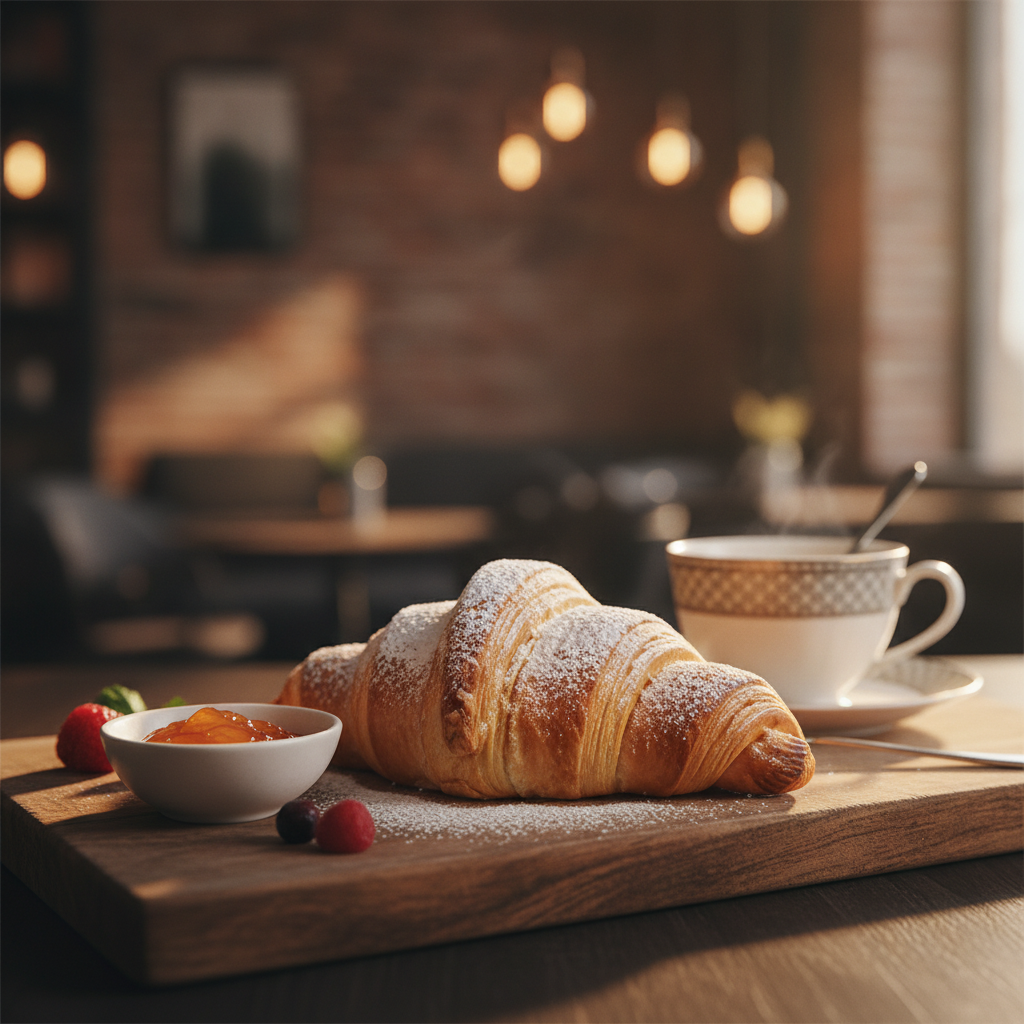
Tradition: The Symbol of French Mornings, A Culinary Experience Offering Life's Leisure
The croissant is not just a simple bread. It is a cultural icon that symbolizes French mornings, and furthermore, embodies the French way of life and leisure. Sitting at an outdoor café in Paris, enjoying a freshly baked croissant with coffee under the warm sunlight, all the hustle and bustle of the world disappear, leaving only peaceful happiness. The croissant is a precious ritual, allowing us to pause in our busy lives and indulge in a small luxury. The crispy crust, when bitten, reveals a rich buttery aroma and a soft interior, providing comfort and solace like a warm conversation with an old friend. For the French, the croissant is an essential part of breakfast, the star of a weekend brunch table, and sometimes a special treat shared with loved ones. It is not merely food to fill the stomach, but an experience that awakens the palate, satisfies the senses, and reminds us of life's small joys. In French households, serving warm croissants at the breakfast table every morning is a tradition, a precious ceremony that strengthens family bonds and starts the day with vitality. The aroma of freshly baked croissants fills the home, waking us up and inviting us into warm memories of childhood. The croissant is thus deeply rooted in French daily life, becoming more than just food; it is a cultural heritage and a philosophy of life. It symbolizes leisure, abundance, and the joy of gastronomy, effectively serving as a delicious messenger that conveys the beauty of France to the world.
History: From Austria to France, The Legendary Crescent-Shaped Pastry
The history of the croissant is far more intriguing and complex than commonly imagined. Many believe the croissant originated in France, but its true beginnings trace back to Vienna, Austria, in the late 17th century. Legend has it that during the Ottoman siege of Vienna in 1683, a baker working through the night heard the sounds of the enemy tunneling, alerted the city, and thus helped avert the attack. To commemorate this heroic deed, the baker created a bread shaped like the crescent moon on the Ottoman flag, called 'Kipferl,' which is considered the precursor to the croissant. While the Kipferl differed in shape and taste from today's croissant, it shared the crescent moon form. So, how did this Austrian bread travel to France and evolve into the modern croissant? Historians speculate that Marie Antoinette, an Austrian princess who married King Louis XVI of France in the late 18th century, introduced the Kipferl to France. Missing the bread from her homeland, she supposedly instructed French bakers to recreate it. However, instead of simply replicating the Austrian Kipferl, French bakers applied their unique pastry techniques, creating a new form of bread with richer butter content and a layered texture. This is what we now know as 'croissant,' meaning 'crescent' in French. Initially, the croissant was not as widespread as it is today; it was primarily a luxury dessert enjoyed by the aristocracy. However, by the mid-19th century, with advancements in baking technology, puff pastry techniques were applied to the croissant, giving it its characteristic light and flaky texture, and it gradually gained popular appeal. In the 20th century, it spread globally, establishing itself as a symbol of French gastronomy. The croissant's history is more than just bread; it is an interesting tale of cultural exchange and technological evolution.
Manufacturing Method: An Art of Layers Forged with Patience and Delicacy
A croissant is not just bread made by mixing flour, butter, and yeast. It is a work of art that embodies the baker's patience, delicacy, and devotion. The traditional croissant making method is very demanding, requiring significant time and effort. The key is the 'lamination' technique, which involves repeatedly layering and folding dough with cold butter to create hundreds of thin layers. First, flour, water, yeast, sugar, and salt are mixed to form a soft dough. This dough must maintain an appropriate consistency, neither too stiff nor too runny. Once the dough is complete, it is rested for a certain period to stabilize the gluten. The next step is the most crucial: working with butter. High-quality cold butter is spread to the right thickness, placed on the dough, and then the dough is folded around the butter like an envelope. At this stage, the butter must not be too hard or too soft. If it's too hard, it can tear the dough; if it's too soft, it will mix with the dough, preventing proper layer formation. Maintaining the correct temperature is essential. The butter-encased dough then undergoes a process called 'turning.' The dough is rolled out long, folded into thirds, rested again, and chilled in the refrigerator. This process is repeated at least three times, with sufficient refrigeration time between each turn to prevent the butter from melting and allow the dough to relax. Through this complex process, hundreds of alternating layers of butter and dough are built within the dough. These layers, when baked in the oven, cause the butter to melt and release steam, which puffs up each layer, creating the characteristic crisp and light texture of the croissant. After all the turning processes are complete, the dough is rolled to the appropriate thickness, cut into crescent shapes, and then proofed again in a warm place. This second proofing allows the croissant to rise and deepens its flavor. Finally, egg wash is brushed on the surface of the proofed croissants before baking them in a hot oven until
Looking for a place nearby? Search “크루아상” on Naver Map.