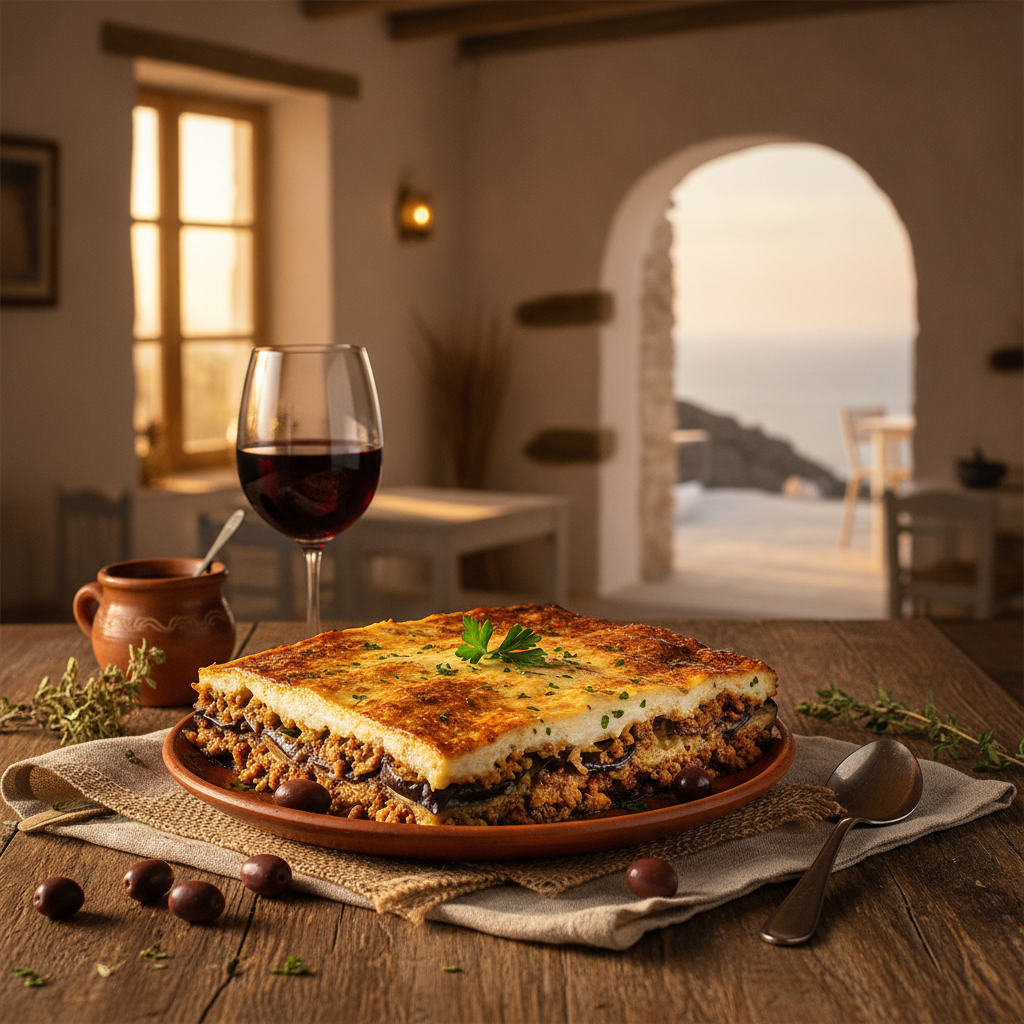
1. Greece and Moussaka: The Aesthetics of Life in Every Bite
In Greece, where the blue waves of the Mediterranean roll, the moment Moussaka appears on the dining table is more than just a meal; it's a ritual. For Greeks, Moussaka symbolizes family bonds, the blessings of fertile land, and a long history and tradition. Like ancient Greek architecture, its layered appearance is both sturdy and elegant, and the substantial weight felt with each scoop reflects the depth and gravity of life itself. On holidays, family gatherings, or when welcoming special guests, Moussaka always takes center stage, captivating everyone's eyes and palates. As it bakes to a golden brown in the hot oven, the aroma of herbs, meat, and cheese fills the house, evoking childhood memories and offering comfort like a mother's home cooking at the end of a tiring day. A single slice of Moussaka encapsulates the Greek way of life—the spirit of 'philoxenia' (hospitality) and a leisurely yet profound philosophy of life. It is not merely food to fill the stomach but the essence of Greek culture that fills the heart and enriches the soul.
2. History and Origins: A Flavor That Bloomed in the Shadow of the Ottoman Empire
Tracing the exact origins of Moussaka reveals fascinating traces of cultural exchange. The name 'Moussaka' is believed to derive from the Arabic word 'musaqqaʿa,' meaning 'chilled.' This suggests that eggplant dishes have existed in the Mediterranean and Middle East for a long time. However, the form of Moussaka we know today, baked in the oven with a béchamel sauce, seems to have become established in Greece between the late 19th and early 20th centuries. In particular, the famous chef Nikolaos Tselementes, who sought to Westernize Greek cuisine, significantly influenced this dish. He introduced the French béchamel sauce, transforming Moussaka into a more refined and rich flavor, which became the standard for the Greek Moussaka we enjoy today. The creation of a unique flavor by combining foreign culture with local ingredients by Greeks, oppressed under Ottoman rule, is like art blooming amidst historical pain. Moussaka, born from the abundant produce of the Mediterranean—eggplant, lamb, tomatoes—combined with sophisticated European cooking methods, is an epic that tells Greece's complex history through taste.
3. Traditional Recipe: The Art of Layered Devotion
Authentic Moussaka is a work of art born from time and dedication. Its core ingredients are divided into three main layers. The first is thinly sliced eggplant, fried or baked until golden brown in olive oil. Eggplant forms the backbone of Moussaka and adds depth to its flavor. The second layer is minced lamb (or beef) flavored with aromatic herbs and tomato sauce. Lamb is predominantly used in Greece, imparting a unique character to Moussaka with its distinct flavor. Finally, a creamy, savory béchamel sauce made with milk, butter, and flour envelops the entire Moussaka, giving it a moist and creamy texture. A touch of freshly grated nutmeg is traditionally added to enhance the flavor.
The cooking process is delicate and requires patience. First, the eggplant is salted to remove bitterness, drained, and then gently cooked in olive oil until tender. This step is crucial for Moussaka's flavor. Next, minced lamb is cooked with sautéed onions and garlic, then simmered with Mediterranean herbs like cinnamon, oregano, and thyme, along with tomato sauce. The meat sauce should be reduced sufficiently to develop a deep flavor. Finally, butter is melted in a pan, flour is added to make a roux, and warm milk is gradually stirred in to create a thick béchamel sauce. Egg yolks are sometimes added for an even smoother consistency.
Once all preparations are complete, layers of cooked eggplant are laid in an oven-safe dish, generously topped with the meat sauce, and then covered with another layer of eggplant, repeating the process. The top is generously covered with béchamel sauce, and grated Greek cheese like Graviera or Kefalotyri is sprinkled over it. Baked in a preheated oven at 180-200℃ for about 40-60 minutes until the béchamel sauce turns golden brown and the ingredients are perfectly melded, the Moussaka is finally complete. Fresh out of the oven, Moussaka emits a glorious aroma with hot steam, a moment when the cook's hard work is most happily rewarded.
4. How to Enjoy It Locally: Experiencing the Greek Table with All Your Senses
Enjoying Moussaka in Greece reflects their leisurely and abundant way of life. Sitting in a Taverna in the Plaka district as the midday sun softens or the evening sun sets, and ordering a slice of Moussaka, is more than just a meal—it's an experience. Locals enjoy Moussaka as a hearty main course. Though freshly baked Moussaka is hot, they don't rush. They slowly savor its warmth, appreciating the harmony of its layered flavors. Moussaka is a fulfilling meal on its own, but it is typically accompanied by a fresh Greek salad (Horiatiki salad). Ripe tomatoes, cucumbers, bell peppers, red onions, generously topped with feta cheese and Kalamata olives, dressed with olive oil and oregano, add a refreshing balance to Moussaka's rich taste.
They also often serve it with a yogurt-based sauce like Tzatziki. Tzatziki, with its cucumber, garlic, and olive oil, makes Moussaka's rich flavors even more diverse. For drinks, a refreshing glass of Retsina wine or traditional Ouzo perfectly completes the Greek ambiance. Retsina, a unique white wine with a pine resin aroma, pairs wonderfully with Greek food. After the meal, the leisurely dining culture of locals often concludes with sweet desserts like Galaktoboureko or Baklava and strong Greek coffee. Eating Moussaka is not just a taste experience but a holistic cultural immersion, feeling the Greek sun, wind, laughter of people, and their rhythm of life with all your senses.
5. Flavor Profile: The Abundance of the Mediterranean in Every Bite
The moment you take a forkful of Moussaka, you experience an ecstasy as if the warm sunshine of the Aegean Sea is pouring into your mouth. The first thing that caresses your tongue is the savory, smooth creaminess of the golden-brown béchamel sauce. This silky-smooth sauce, combined with the subtle aroma of nutmeg, leaves a deep impression from the first bite. Then, the rich flavor of the fluffy yet moist minced meat bursts forth. The deep, rich taste characteristic of lamb perfectly harmonizes with the refreshing acidity of tomatoes and the fragrant notes of Mediterranean herbs like oregano and cinnamon. This meat sauce melts gently on the tongue, forming complex layers of flavor, much like a stew simmered for a long time.
And underpinning all these flavors is the humble eggplant. Softly cooked in olive oil, the eggplant offers its subtle sweetness and juicy tenderness, acting as a buffer between the meat and béchamel sauces. The slightly charred edges of the eggplant add a hint of smoky flavor, deepening the taste. The symphony of flavors that unfolds in your mouth when these three elements come together is truly overwhelming. Warm and moist, savory and rich, with the fragrance of herbs and the deep taste of meat, the complex flavor will satisfy any gourmet. A full bite reveals the diverse textures of the layered ingredients—the creamy béchamel, the slightly chewy meat, and the melting eggplant—creating an unforgettable culinary experience. Moussaka is more than just a dish; it is a masterpiece of taste that embodies the abundance of the Mediterranean and the passionate energy of Greek life on a single plate.
Looking for a place nearby? Search “무사카” on Naver Map.