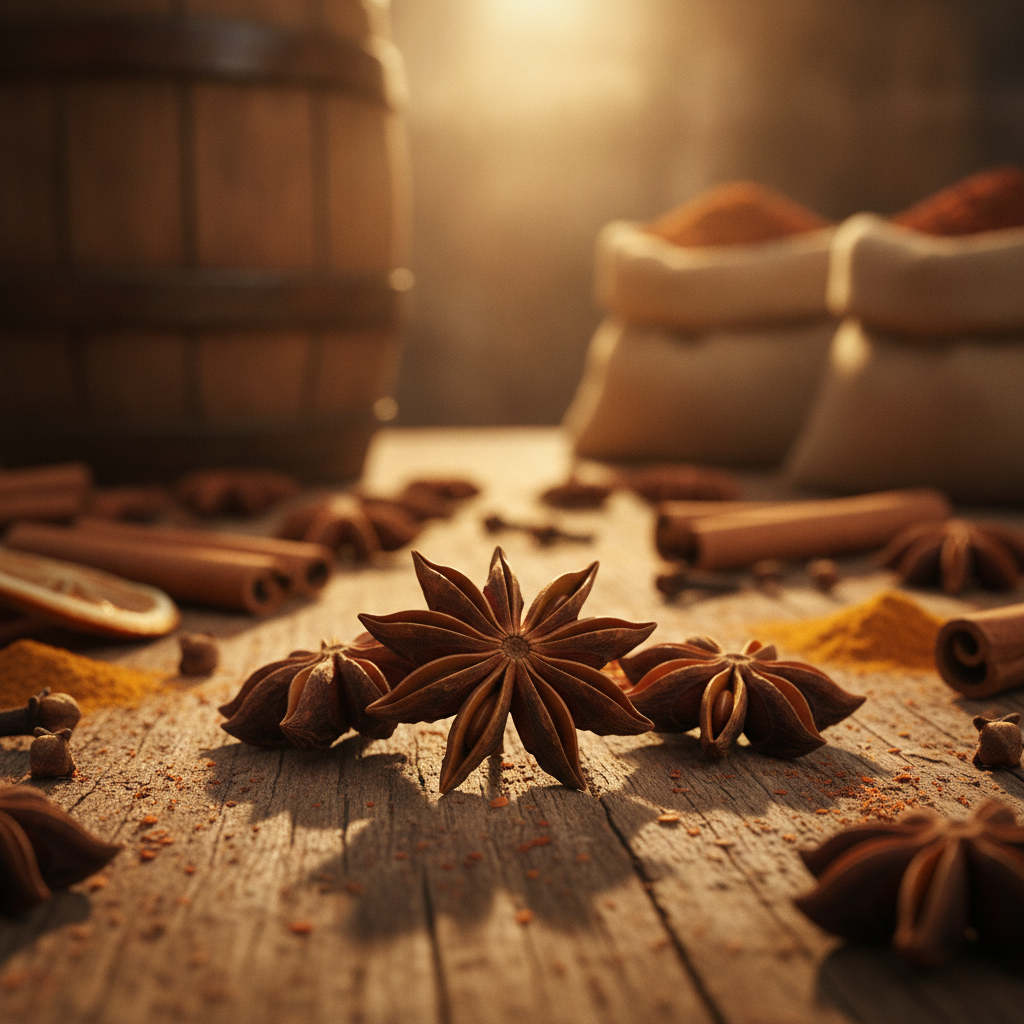
1. The Allure of Star Anise
Star anise, resembling a star in the night sky, is imbued with mystery from its very name. Its geometric beauty, formed by eight pointed pods, like a miniature universe condensed, is visually stunning. However, the true allure of star anise lies in its unique and intense aroma. Upon first whiff, there's a pungent spiciness that tingles the nose, followed by a sweetness reminiscent of licorice, and deep within, subtle woody and earthy notes intertwine, creating complex layers. This aroma doesn't just enhance the flavor of food; it possesses a magical power to infuse the entire dish with an exotic, warm, and comforting ambiance. Its true value shines when heated; the fragrance of star anise dancing in the hot steam evokes the sensation of wandering through a mystical Eastern forest. It excels at eliminating gamey odors from meats and deepening their flavor, permeating ingredients during simmering and stewing to deliver an unforgettable culinary experience. The olfactory orchestra created by a single piece of star anise transcends mere spice, reaching the realm of art. The boundless charm held within this small star is like an invitation guiding us to an unknown world.
2. History and Spice Trade
The history of star anise begins in ancient times, at the eastern end of the Silk Road. Native to southern China and northern Vietnam, star anise was widely used in the region's food and medicine from an early age, its unique aroma soon ready to spread westward. As early as BCE, star anise was used in China for medicinal purposes, added to dishes to enhance flavor, and even utilized as an air freshener. Along with tea and silk, star anise spread through the Silk Road to Central Asia and the Middle East, where merchants were captivated by its charm and treated it as a valuable commodity. However, it was truly introduced to Europe in the 16th century, carried by Dutch merchants during the Age of Discovery. Alongside nutmeg, cloves, and cinnamon, star anise was regarded by Europeans as a precious spice symbolizing the mystery and wealth of the East. At that time, spices were luxuries as costly as gold, and the competition to acquire them led to fierce exploration and trade wars. Star anise played a crucial role as a link between Eastern and Western cultures amidst geographical discoveries and colonial struggles. From this small, star-shaped spice being loaded onto countless explorers' ships to cross oceans, gracing royal tables, and filling apothecaries' shelves, its journey is nothing short of a dramatic epic intertwined with human history and desire. Star anise is not just an ingredient; it is a passage of time connecting past and present, and evidence of civilizational exchange.
3. Origin and Cultivation
The home of star anise is the lush subtropical forest regions of Guangxi Province in southern China and northern Vietnam. The fertile soil and mild, humid climate here provide optimal conditions for the star anise tree (Illicium verum) to thrive. The star anise tree is an evergreen broadleaf tree, growing to a height of approximately 5-10 meters, bearing beautiful green leaves and yellowish-green flowers. The star-shaped star anise we commonly see is the dried fruit of this tree. The fruit initially appears green, then ripens to a dark brown, with each carpel containing a single seed. The star anise tree demands great patience, taking about 6 years after planting the seed before the first harvest, and then it can bear fruit for over 100 years, making it a long-lived tree. Harvesting primarily occurs in the autumn, with ripe fruits either hand-picked or shaken off with long poles. The harvested fruits immediately undergo a drying process, using sunlight or hot-air dryers to remove moisture. This process completes the unique aroma, color, and firm texture of star anise. For the residents of its origin, star anise is not just a crop but a part of their lives and a tradition passed down through generations. They cultivate and harvest star anise meticulously, grateful for nature's bounty. Each star anise tree embodies the vitality of nature, the sweat of its cultivators, and the wisdom of long years. All these elements combine to produce the beautiful star-shaped star anise we encounter.
4. Culinary Uses
Star anise, with its intense and distinctive aroma, is an indispensable core spice in Eastern cuisine, especially Chinese and Vietnamese dishes. It excels at eliminating gamey odors from meats and deepening their flavor, making it essential in various meat dishes such as roasted duck, braised pork, and beef stew. It is one of the main ingredients of Chinese Five-Spice Powder (Wǔxiāngfěn), which is used as a seasoning or marinade in numerous Chinese dishes. Star anise also plays a crucial role in creating the deep and rich broth of Vietnam's national dish, 'Phở'. Its warm and sweet aroma exquisitely balances the flavors of meat while counteracting greasiness. Beyond meats, star anise can add an unexpected charm to vegetable or seafood dishes. When cooked with root vegetables like carrots, onions, and pumpkins, it emphasizes their sweetness and infuses an exotic fragrance. Furthermore, star anise is utilized in sweet desserts and beverages. In the West, it's added to mulled wine (Glühwein/Vin Chaud), apple pie, or gingerbread during the Christmas season to impart a warm, exotic aroma. It pairs well with cinnamon, cloves, and ginger, creating even richer and more diverse flavors when used together. When using star anise, it's important to use a small amount due to its strong aroma. It is typically added whole and removed after the dish is cooked, and if using in powdered form, only a very small amount should be used. Star anise is a magical spice that adds depth and character to cuisine, and its uses are endless.
5. Health Benefits
Star anise has not only been valued for enhancing culinary flavors but has also been recognized for various health benefits throughout its long history. In traditional Eastern medicine, star anise is called 'Hui Xiang' (fennel) and is believed to have warming properties that help heat the body and promote qi and blood circulation. It is particularly known to be effective in alleviating gastrointestinal disorders such as indigestion, abdominal pain, and diarrhea, helping to promote gastrointestinal motility and expel gas. Furthermore, modern scientific research has revealed that star anise possesses powerful antioxidant and anti-inflammatory properties. The compound 'Anethole', abundant in star anise, is the main component responsible for its distinctive aroma and is known for its antimicrobial and antiviral effects. Star anise also gained global attention when it was discovered that 'Shikimic acid', a key ingredient in 'Tamiflu', a widely used influenza treatment, is extracted from star anise. This suggests that star anise can also help boost immunity and prevent colds. In addition, studies have reported potential effects of star anise in helping to regulate blood sugar or inhibit the growth of certain cancer cells. Of course, this cannot replace medical treatment, and excessive consumption can cause side effects, so caution is advised. However, when consumed in appropriate amounts, star anise is undoubtedly a precious gift from nature for maintaining our health. The process of traditional wisdom and modern science coming together to uncover the hidden benefits of star anise is truly fascinating.
6. Purchasing & Storage Tips
Choosing good quality star anise is a crucial step that determines the taste and aroma of your cooking. The first thing to check is its shape. Star anise should have its eight pointed pods intact, with minimal breakage, as its name suggests. While the number of pods can occasionally be 7 or 9, generally, a clear and uniform star shape is preferred. The color should be a deep reddish-brown with a slight sheen, indicating freshness. If it looks too black or brittle, it might be old or improperly dried. The aroma is also an important criterion. When held close, it should emit a strong, sweet yet spicy fragrance characteristic of star anise. Avoid any with a musty or rancid smell. Whole star anise retains its aroma longer than ground form, so if possible, purchase whole star anise and grind it as needed. Proper storage is vital for the life of spices. Because star anise has a strong and volatile aroma, it should be stored in an airtight container in a cool, dry place away from direct sunlight. Humidity can weaken its aroma and cause mold, so particular care should be taken. When stored correctly, whole star anise can maintain its quality for 1-2 years, but ground form loses its aroma much faster, so it's best to use it within 6 months. Well-stored star anise will add deep flavor to your dishes and bring the joy of discovering a hidden treasure.
7. Recommended Recipes
(1) Star Anise Braised Pork Belly (Dongpo Pork)
Dongpo Pork, a signature dish of Shanghai cuisine, is the best way to experience the true essence of star anise. The tender pork belly, infused with the deep aroma of star anise, creates a fantastic flavor.
Ingredients: 1kg pork belly (whole), 3 whole star anise, 1 piece fresh ginger (sliced), 2 stalks green onion (white part), 1 cup soy sauce, 1/2 cup sugar, 1/2 cup rice wine, 3 cups water
Instructions:
- Blanch the pork belly briefly in boiling water to remove impurities, score the skin side, and cut into large bite-sized pieces.
- Place the pork belly in a pot, add star anise, ginger, and green onion. Pour in soy sauce, sugar, rice wine, and water until the pork is just submerged.
- Cover the pot and simmer over low heat for 1 hour 30 minutes to 2 hours until very tender. Flip occasionally and add a little more water if the liquid reduces too much.
- Once the pork is tender and thoroughly flavored, it's ready. Serve with blanched bok choy or broccoli for a better experience.
(2) Star Anise Spiced Mulled Wine (Glühwein/Vin Chaud)
On a cold winter's night, a glass of mulled wine infused with the warm aroma of star anise will be a special experience that warms both body and soul.
Ingredients: 1 bottle red wine (750ml), 2 whole star anise, 2 cinnamon sticks, 5-6 cloves, 1 orange (sliced), 1/2 apple (sliced), 3-4 tablespoons sugar (adjust to taste)
Instructions:
- Pour the red wine into a saucepan. Add the star anise, cinnamon sticks, cloves, orange slices, and apple slices.
- Add sugar and slowly bring to a simmer over medium-low heat. Once the wine begins to simmer, reduce the heat to very low and continue to cook for about 15-20 minutes to allow the flavors to infuse thoroughly. Be careful not to let it boil vigorously.
- Strain through a sieve to remove the fruit and spices, then serve warm in glasses.