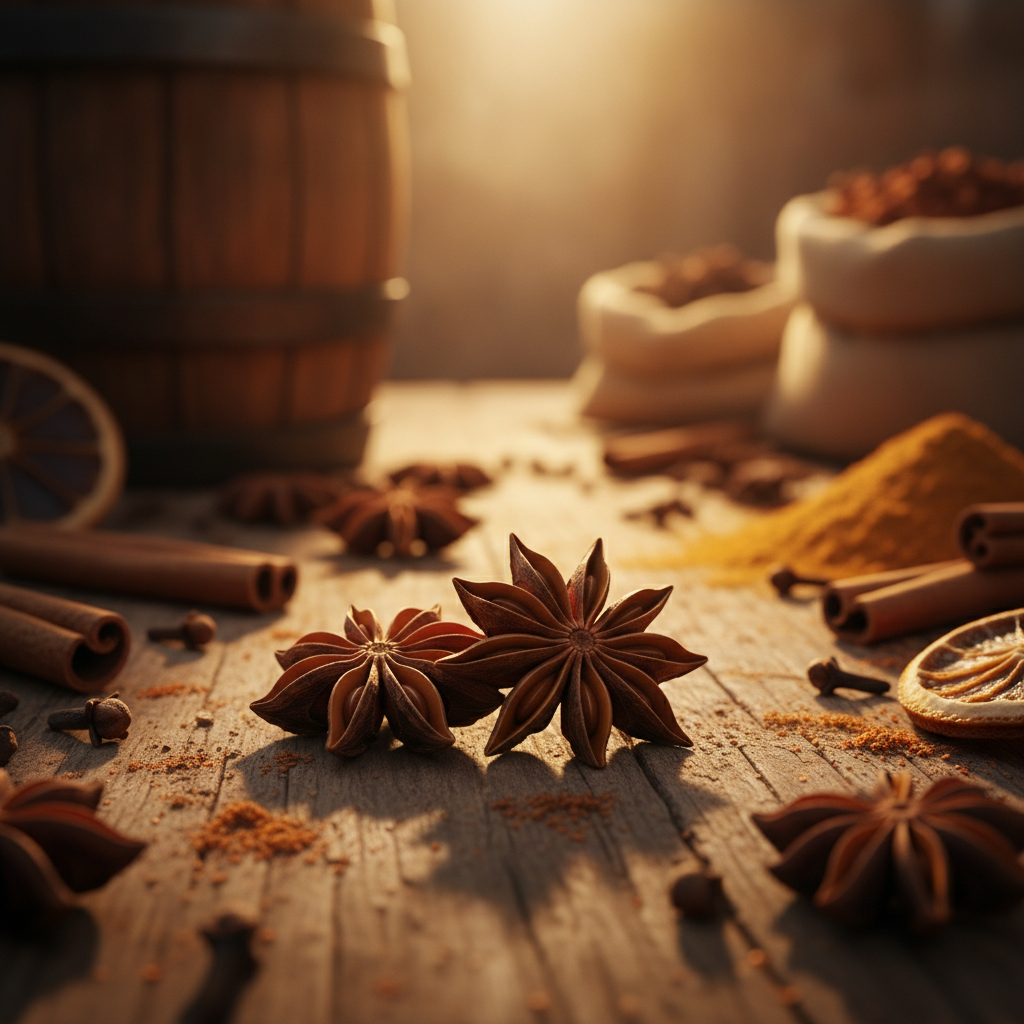
The Whisper of Stars, Star Anise: Embracing the Mystical Scent of the East
1. The Allure of Star Anise
Star Anise, resembling the tiny stars adorning the night sky, is a spice as mysterious and captivating as its name suggests. The perfect symmetry formed by its eight pointed carpels is like a work of art crafted by nature, encapsulating a complex aroma where sweetness, pungency, and a bitter medicinal scent are exquisitely intertwined. The moment you first encounter the fragrance of star anise, you are transported into a serene tranquility, as if stepping into a quiet temple in the Orient, and at the same time, plunged into an ecstatic vision where exotic landscapes unfold before your eyes. Thanks to anethole, a compound similar to that found in anise seeds, star anise possesses a sweet, licorice-like flavor, but it adds warm, spicy notes reminiscent of cloves and cinnamon, along with a deep, earthy, bitter finish. This unique spectrum of aromas is excellent for neutralizing gamey odors in meat and enhancing its flavor, while also imparting unexpected depth and exotic charm to sweet desserts. Star anise is more than just a seasoning; it is a magical entity that imbues dishes with stories and breathes soul into them. The universe of scent offered by this small star guides us to a new dimension of gastronomy, providing an unforgettable aromatic experience.
2. History and Spice Trade
The history of star anise began in the remote mountains of China and northern Vietnam, breathing alongside the rise and fall of Eastern civilizations. Records indicate that it was used as a medicinal herb and spice as early as the 3rd century BCE during the Qin Dynasty, proving its long-standing revered status in the East. Its value escalated as it began to spread westward along the Silk Road, eventually reaching the Middle East and Europe through the hands of Arab merchants. However, star anise became widely known in the Western world only after the Age of Discovery. In the 16th century, Portuguese explorers charted new routes to Southeast Asia, discovering a treasure trove of spices, among which star anise captivated European aristocrats with its mysterious aroma and efficacy. This star-shaped spice from the East was treated as more precious than gold, securing its position as an important commodity in the spice trade. Star anise, having journeyed across treacherous seas, offered both exotic flavors and mystical medicinal properties to Westerners, intertwined with their fascination for the unknown Orient. At that time, the trade of star anise was more than just buying and selling goods; it was a crucial catalyst that promoted cultural exchange between East and West and redrew the world map. The immense wave of history contained within a single piece of star anise continues to inspire us profoundly to this day.
3. Origins and Cultivation
The homeland of star anise is the subtropical forest region of southern China and northern Vietnam. Specifically, Guangxi province in China and the northern regions of Vietnam provide optimal conditions for star anise trees to thrive. The star anise tree (Illicium verum) is an evergreen tree that prefers warm, humid climates and fertile soil. Growing to a height of 8 to 15 meters, its small yellowish flowers that bloom among green leaves are inconspicuous, but the fruits that follow reveal the true beauty of star anise. The fruits are initially green, then turn reddish-brown as they ripen, forming the familiar star shape. Harvesting typically takes place from late autumn to early winter, with the fruits being hand-picked just as they begin to turn red, before they are fully ripe. Harvesting too early results in less fragrance, while harvesting too late makes them susceptible to pests, so timing is crucial. The harvested fruits are sun-dried to remove moisture. This drying process concentrates and deepens the unique aroma of star anise, transforming them into the spice we use. Cultivation and harvesting are often done by small family farms using traditional methods rather than large-scale plantations, meaning that each piece of star anise embodies the sweat and dedication of its producers. They tend to the star anise trees in harmony with nature's rhythm, harvesting the mysterious star-shaped fruits annually and preserving the tradition of star anise.
4. Culinary Applications
Star anise is an indispensable key spice in Asian cuisine, especially Chinese and Vietnamese dishes. Its unique aroma adds depth and flavor to food, infusing it with an exotic charm. The most common application is in meat dishes. When cooking red meats such as pork, beef, or duck, adding star anise effectively removes gamey odors and imparts a subtle yet rich fragrance. This is precisely why star anise is essential in Chinese Hong Shao Rou (braised pork belly) and Vietnamese Pho broth. Especially in Pho, the sweet yet spicy aroma of star anise plays a decisive role in completing the deep flavor of the broth. Furthermore, star anise pairs wonderfully with steamed dishes, braised dishes, and marinades. Sauces made with soy sauce, sugar, chili, and star anise can add a distinctive flavor to seafood or tofu dishes. Surprisingly, star anise can also be used in desserts. A small amount of star anise added to warm apple pie, pear compote, or chocolate desserts can provide unexpected depth and an exotic twist. It pairs well with cinnamon, cloves, ginger, and orange peel, and using them together can create an even richer and more complex aroma. The presence of star anise varies with the amount used, so it's best to start with a small quantity and gradually adjust when using it for the first time. This small star will open up a new horizon of mystical Eastern flavors and tastes on your dining table.
5. Health Benefits
Star anise is more than just a spice that enhances the flavor of food; it has been used as a valuable medicinal ingredient in Eastern traditional medicine for thousands of years. Its most well-known benefit is aiding digestion. The anethole compound in star anise helps activate gastrointestinal motility and assists digestion. It can help alleviate indigestion, bloating, and gas, making it a soothing post-meal tea or an additive to food. Moreover, star anise has warming properties, making it beneficial for warming the body and improving blood circulation. It is also known to help alleviate early cold symptoms, coughs, and phlegm. Modern scientific research is also revealing various health benefits of star anise. Star anise is rich in powerful antioxidant compounds, which protect cells from free radicals and contribute to anti-aging. Of particular note is shikimic acid, extracted from star anise. Shikimic acid possesses strong antiviral properties, to the extent that it is used as a key raw material for Tamiflu, an influenza treatment. This provides scientific backing for the traditional belief that star anise can help prevent and alleviate cold and flu symptoms. Its antibacterial and anti-inflammatory properties are also among the main benefits of star anise, showing potential in the prevention and treatment of various inflammatory diseases. While it is a spice and not a medicine, excessive consumption should be avoided. However, used appropriately, star anise is an excellent natural gift that offers both flavor and health.
6. Purchase & Storage Tips
Purchasing good quality star anise is a crucial step that determines the taste and aroma of your cooking. When choosing star anise, first examine its shape carefully. Look for clear, distinct star shapes with minimal breakage or crumbling. The color should be a deep reddish-brown; avoid those that are too black or whitish. Most importantly, check the aroma. Fresh, good quality star anise will have a strong, characteristic sweet, warm, and spicy scent. It should not have any musty or damp smells. It's best to choose those that appear shiny and firm to the eye. While ground star anise powder is available, for the preservation of aroma and depth of flavor, it is recommended to purchase whole star anise. Whole star anise can be ground as needed, allowing you to enjoy a fresher fragrance. Once purchased, it's important to protect star anise from air and moisture. It should be stored in an airtight container in a cool, dry place away from light. Direct sunlight or hot and humid environments can quickly degrade the aroma and reduce the efficacy of star anise. Stored correctly, star anise can retain its fragrance and flavor for up to 2-3 years. However, the aroma gradually weakens over time, so it's best to use it within a year if possible. Star anise powder tends to lose its aroma faster than whole star anise, so it's wise to buy it in small quantities and use it quickly. Store good quality star anise well to always add the mystical aroma of the East to your dishes.
7. Recommended Recipes
1) Star Anise Braised Pork Belly (Hong Shao Rou inspired)
Ingredients: 500g pork belly, 2-3 whole star anises, 1 cinnamon stick, 3-4 slices ginger, 3-4 cloves garlic, 4 tbsp soy sauce, 2 tbsp sugar, 2 tbsp rice wine or cooking sake, 2 cups water, a little cooking oil
Instructions:
- Cut pork belly into large pieces, blanch briefly in boiling water to remove impurities, rinse with cold water, and drain.
- Heat a little cooking oil in a pot, add sugar, and melt over low heat until it caramelizes. (Be careful not to burn it.)
- Once caramelized, add the pork belly and stir-fry until the surface is golden brown.
- Add star anise, cinnamon stick, ginger, and garlic, and stir-fry gently until fragrant.
- Add soy sauce, rice wine (or cooking sake), and water. Bring to a boil over high heat, then reduce to low, cover, and braise for at least 1 hour until the pork is tender.
- Stir occasionally, and if the liquid reduces too much, add a little more water.
- Once the meat is sufficiently tender and well-seasoned, it's done. Enjoy with warm rice.
2) Star Anise Pear Compote
Ingredients: 2 firm pears, 1 whole star anise, 1/2 cinnamon stick, 2 tbsp sugar (adjust to taste), 1/2 cup water, 1 tbsp lemon juice
Instructions:
- Peel and core the pears, then cut them into bite-sized pieces.
- In a saucepan, combine the sliced pears, whole star anise, cinnamon stick, sugar, water, and lemon juice.
- Bring to a boil over medium heat, then reduce to low, cover, and simmer for 10-15 minutes until the pears are tender. (Adjust time depending on the type of pear.)
- Once the pears are tender, turn off the heat and remove the star anise and cinnamon stick.
- Serve warm or chilled with yogurt, ice cream, or on toast. The subtle aroma of star anise enhances the sweetness of the pears.
Star anise, as shown, adds magical flavor to various dishes, tantalizing our palates. Explore the endless possibilities offered by this small star.