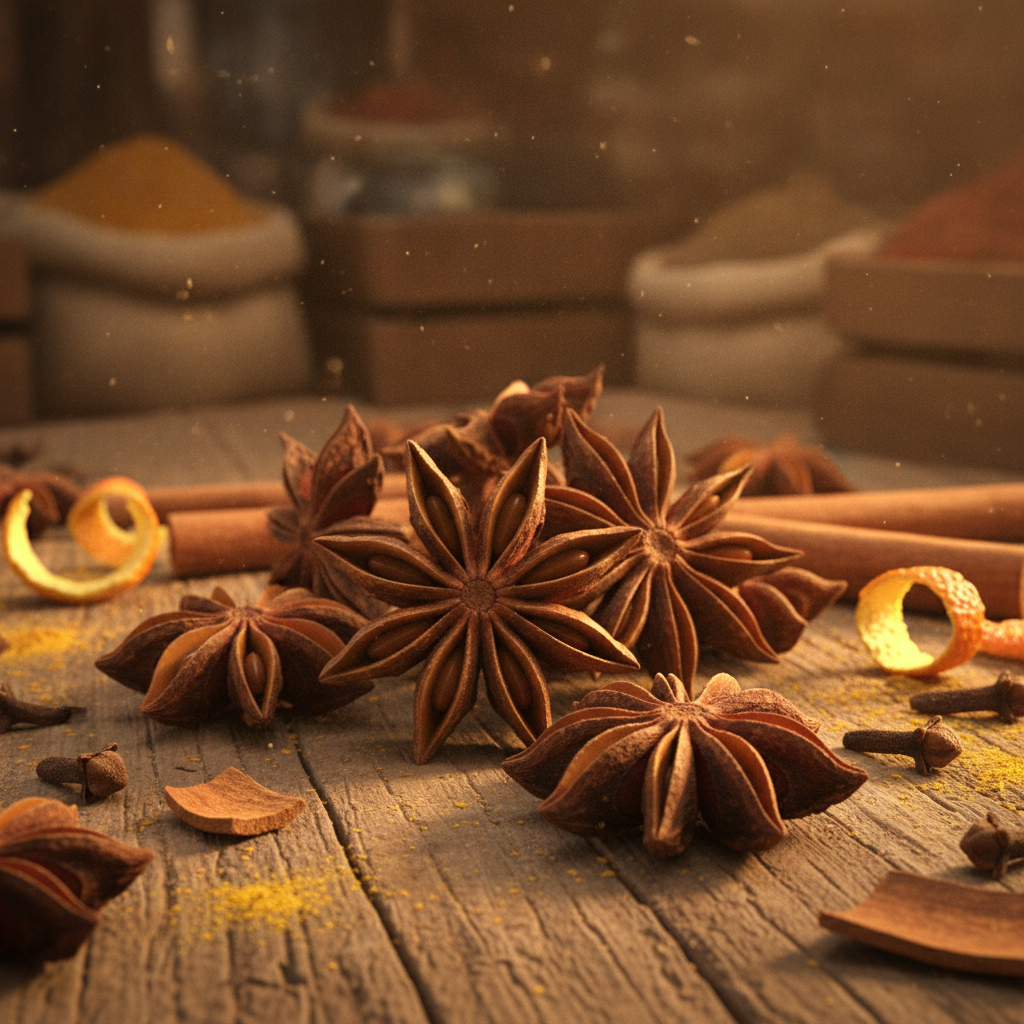
Whisper of Stars, Star Anise: Embracing the Mysterious Scent of the East
1. The Charm of Star Anise
Like a small star twinkling in the dark, star anise, or simply anise, holds a mysterious and exotic fragrance that leaves an unforgettable impression. Like the fruit of an unfamiliar tree encountered while strolling through a deep forest, or the incense rising from a serene temple in the East, star anise invites us into an unknown world. Its unique aroma, both sweet and pungent, warm yet refreshing, seems to gather the warmth of cinnamon, the subtle sweetness of licorice, and the freshness of fennel all in one. The moment it touches the nose, the intense flavor that lingers on the tongue offers a culinary adventure beyond a mere spice. This is like tasting a piece of Orientalism, a magic that gently wraps the richness of red meat and infuses Eastern philosophy into a hot cup of tea. Star anise is an art in itself, a secret key that adds depth and soul to cuisine. Its charm, delicately unraveling complex layers of aroma and breathing new life into familiar ingredients, has captivated many hearts across ages. The infinite possibilities held within a small star—that is the true charm of star anise.
The scent of star anise is more than just a spice; it's a mysterious whisper from the East, inviting us into an unknown world.
2. History and Spice Trade
The history of star anise is deeply intertwined with ancient Eastern tales. Born in the lush forests of southern China and northern Vietnam, this small star has played a crucial role in traditional Chinese medicine and cuisine for thousands of years. Beginning its journey westward along the Silk Road, star anise was considered a precious medicinal herb in the Middle Ages, and its unique aroma stimulated European curiosity. With the advent of the Age of Discovery, the spice trade underwent a period of dramatic change, and star anise stood at its center. Portuguese, Dutch, and English merchant ships traversed Asian seas in search of star anise, making it an important commodity connecting East and West. Especially in the 17th century, as it began to flow into Europe in large quantities, star anise opened new horizons in culinary culture and medicinal applications. At that time, star anise, alongside nutmeg, cloves, and cinnamon, was sometimes regarded as a symbol of wealth and power. The fierce competition and exploration to acquire spices marked a page in human history, and star anise played a significant role as a bridge connecting Eastern and Western cultures in that dynamic flow. Beyond a simple ingredient, star anise represented the dreams of explorers, the aspirations of merchants, and humanity's endless curiosity about the unknown. The story contained within that small star is like a great epic of human civilization, transcending mere spice.
During the Age of Discovery, star anise became a bridge connecting Eastern and Western cultures, embodying the dreams of explorers and the aspirations of merchants.
3. Origin and Cultivation
The homeland of star anise is the Guangxi province in southern China and the mountainous regions of northern Vietnam. The subtropical climate and fertile soil there provide optimal conditions for the star anise tree to thrive. The star anise tree (Illicium verum) is an evergreen tree that grows up to 5-10 meters tall, bearing glossy green leaves and beautiful flowers. The fruit of this tree is the star-shaped star anise we know. It takes about six years after planting a seed to get the first harvest, and then it continues to bear fruit for decades. Harvesting usually takes place in the fall, requiring the delicate work of hand-picking the fruit before it is fully ripe. The immature, greenish fruits are harvested and dried in the sun, transforming into the reddish-brown star anise we commonly see. This drying process concentrates the intense aroma and flavor characteristic of star anise. Star anise trees often require little special care and are grown in an eco-friendly manner, which further deepens the natural flavor of the spice. Farmers carefully dry and sort the harvested star anise before sending it worldwide, with each step preserving the value and aroma of the spice. Growing quietly in the lush forests, the star anise tree, like a gift from nature, bestows the mysterious scent of the East upon our tables.
The star anise tree, grown in the subtropical forests of China and Vietnam, is a gift from nature and a treasure containing the mysterious scent of the East.
4. Culinary Uses
Star anise is an indispensable core spice in Eastern cuisine, especially Chinese and Vietnamese dishes. Its intense yet sweet and slightly bitter aroma adds deep flavor to meat dishes and effectively eliminates gamey odors. It is an essential ingredient in Chinese five-spice powder and is arguably the soul of the broth for pho, the representative Vietnamese noodle soup. Braised beef or pork cooked with whole star anise infuses a subtle aroma into the meat, making it even more appetizing, and it can also be used in steamed or stir-fried dishes to enhance their flavor. Star anise pairs particularly well with duck, pork, and beef, and when used with soy sauce, sugar, ginger, and garlic, it can create even deeper flavors. In the West, star anise is also used in warm beverages and desserts. It can be added to mulled wine like Glühwein to enhance its aroma, or it can infuse a subtle fragrance into apple tarts and pear compotes. Star anise is a versatile spice that breathes fresh aroma into the richness of meat dishes while adding an exotic depth to the sweetness of desserts. The culinary variations created by a single small star are endless, and star anise becomes a source of inspiration that stimulates a chef's imagination. Its strong presence reveals itself in any dish it enters, transforming ordinary food into an extraordinary gourmet experience.
Star anise enhances the depth of meat dishes, becomes the soul of pho broth, and infuses exotic depth into desserts—a truly versatile spice.
5. Health Benefits
Beyond simply adding flavor to dishes, star anise has been used as an important medicinal herb in traditional medicine for centuries. In traditional Chinese medicine, star anise is known to have a warm nature, aiding digestion, soothing the stomach, and promoting the circulation of qi (energy). Modern scientific research has also revealed various benefits of star anise. One of the main active compounds in star anise, shikimic acid, possesses powerful antiviral properties, so much so that it is used as a key ingredient in the antiviral drug Tamiflu. This suggests that star anise may help prevent colds and flu. Furthermore, star anise is rich in antioxidants, which contribute to removing free radicals in the body and preventing cell damage, potentially having a positive impact on anti-aging and chronic disease prevention. Some studies report that star anise has antibacterial and anti-inflammatory effects, which can aid in improving digestive health and reducing inflammation. However, as star anise is a potent spice, excessive consumption should be avoided, and it is advisable for pregnant women or individuals with specific conditions to consult a professional before consumption. These health benefits contained within the small star-shaped star anise remind us once again that it is a gift from nature that protects the health of our body and mind, beyond being a mere spice.
Star anise contains shikimic acid, a powerful antiviral compound, and acts as a gift from nature, promoting digestion and providing antioxidant benefits for body and mind.
6. Purchasing & Storage Tips
Choosing good quality star anise is a crucial step that determines the taste and aroma of your cooking. The first thing to look for is the shape of the star anise. It should have a clear brown color, and its star points should be intact and unbroken. The clearer the points and fewer broken parts, the fresher and better dried the star anise is likely to be. Also, check that the surface is glossy and free from dust or foreign matter. The aroma is the most important factor in judging the quality of star anise. It should have a strong, sweet, and unique fragrance with a hint of freshness. Avoid any that smell moldy or damp. It is best to purchase whole star anise. Powdered forms tend to lose their aroma quickly, so it's better to grind whole star anise as needed. Once purchased, star anise should be stored in an airtight container in a cool, dry, and dark place. Direct sunlight and humidity can quickly degrade the aroma and flavor of star anise, so be careful. When stored correctly, star anise can retain its fragrance for several years. Freezing is also possible, but it is important to double-seal it to prevent moisture from accumulating. To enjoy the aroma and flavor contained in a small star for a long time, a little extra effort in purchasing and storage is needed.
Good star anise has a clear brown color, an intact star shape, and a strong, unique aroma. Store it in an airtight container in a cool, dry place to preserve its fragrance for a long time.
7. Recommended Recipes
(1) Star Anise Braised Pork Belly
This dish is a classic Chinese recipe where the rich aroma of star anise maximizes the flavor of pork belly. The tender braised pork and the exotic scent of star anise create an irresistible combination that's perfect with rice.
Ingredients: 500g pork belly, 3 whole star anise, 5 slices ginger, 5 cloves garlic, 1/2 cup soy sauce, 3 tbsp sugar, 2 cups water, a little cooking oil, 2 tbsp rice wine (or mirin).
Instructions:
- Cut the pork belly into bite-sized pieces.
- Heat a little cooking oil in a pot and sauté the pork belly until browned on all sides.
- Once the pork belly is browned, add the whole star anise, ginger, and garlic, and sauté until fragrant.
- Add soy sauce, sugar, rice wine, and water. Bring to a boil over high heat, then reduce to low, cover, and braise for at least 1 hour until tender. Flip occasionally and add a little more water if the liquid reduces too much.
- When the pork is tender and the sauce is reduced, turn off the heat and serve with warm rice.
(2) Subtle Star Anise Apple Compote
Star anise also creates an unexpected harmony with sweet desserts. The freshness of apples and the exotic aroma of star anise combine to offer a unique dessert experience.
Ingredients: 2 apples, 1 whole star anise, 3 tbsp sugar, 1 tbsp lemon juice, 1/4 cup water.
Instructions:
- Peel the apples, remove the cores, and cut them into large pieces.
- In a saucepan, combine the sliced apples, whole star anise, sugar, lemon juice, and water. Cook over low heat.