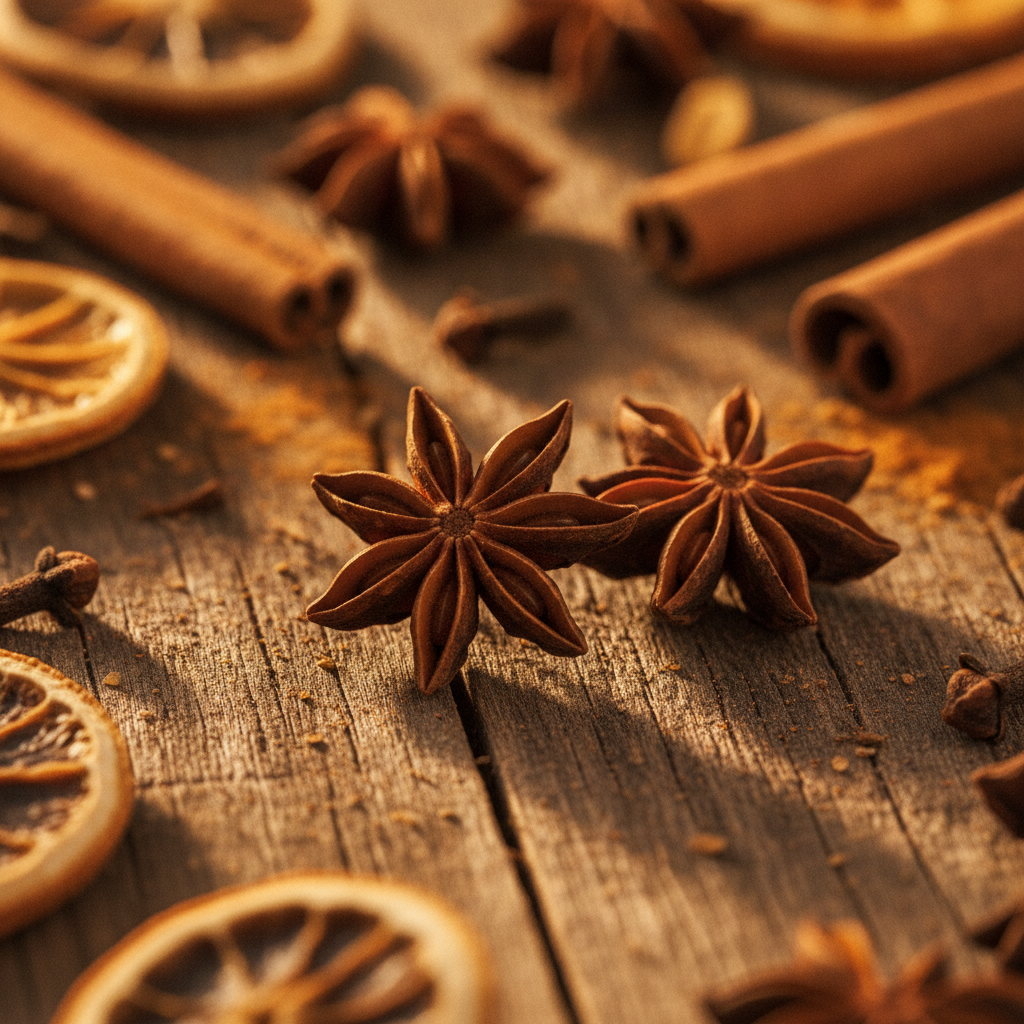
Whisper of the Star, Star Anise: A Mystical Tale of the Eastern Spice
1. The Allure of Star Anise
Like a small star adorning the night sky, star anise captivates with its beautiful octagonal shape. But the true charm held within this star-shaped fruit is revealed the moment its aroma wafts to your nose. Sweet yet pungent, warm yet exotic, its complex fragrance immediately transports us to the mysterious ambiance of the Orient. Like a secret flower blooming deep in the forest, star anise boasts a unique flavor profile that seems to intertwine the gentle warmth of cinnamon, the intense kick of cloves, and the subtle sweetness of licorice. As an assistant in removing gamey odors from meat dishes and adding deep flavor, or sometimes as a protagonist offering an unexpected twist to desserts, star anise silently yet powerfully asserts its presence. The magical power to transform the character of an entire dish with just one piece – that is the irresistible allure of star anise. This aroma is more than just an olfactory experience; it carries an emotional resonance, evoking the long history and culture of the East, and warm memories of home-cooked meals. Every time we encounter the scent of star anise in a sip of tea or a plate of food, we feel as if we are embarking on a small journey to an unknown world.
2. History and Spice Trade
The history of star anise stretches back to ancient times, much like the silken flow of the Silk Road. Growing wild in the deep mountainous regions of southern China and northern Vietnam, it quickly became an important spice in Eastern cultures. In ancient China, it was also used as a medicine and played a crucial role in shaping the identity of Chinese cuisine as a key ingredient in Five-Spice Powder (五香粉). Star anise was first introduced to Europe in the 16th century by Portuguese traders, riding the wave of the Age of Discovery. Along with other precious spices like nutmeg, cloves, and pepper, star anise became a vital trade commodity that stimulated the desire of European powers to open new trade routes. This star-shaped spice from the mysterious East brought a fresh shock to European tables and soon became popular for flavoring gingerbread and warm beverages. The spice trade was more than just buying and selling goods; it was a conduit for cultural and civilizational exchange. Through this channel, star anise spread the mystical tastes and aromas of the East to the West, serving as an important bridge connecting the culinary worlds of East and West. The fact that we can easily access cuisines from around the globe today is largely due to this long history of spice trade. Star anise is not just a spice; it is an icon symbolizing the exchange and development of human civilization.
3. Origin and Cultivation
The homeland of star anise is the lush mountainous region of Guangxi Province in southern China and northern Vietnam. The subtropical climate here provides an ideal environment for star anise trees to flourish. Star anise trees are evergreen, growing to heights of up to 20 meters, with glossy dark green leaves and beautiful yellow flowers. After these flowers fade, the star-shaped fruit we know as star anise develops. These fruits are initially green and then turn reddish-brown as they ripen, becoming firm. Harvesting primarily occurs in the autumn, by picking the fruits directly from the trees. Harvesting perfectly ripe fruits is crucial for determining the flavor of star anise, making the skilled hands of experienced farmers essential. The harvested star anise then undergoes a drying process, either by sun-drying or in a dehydrator. This drying process concentrates the strong and complex aroma unique to star anise and transforms it into a form suitable for storage. Star anise, a gift from nature, is born as a perfect spice through the harmonious blend of its native climate, soil, and the diligent efforts of people. Imagine the star anise trees quietly growing in the vast wilderness. Within them lies centuries of time, and the energy of the earth and sky is condensed. The greatness of nature and the toil of human effort contained in this small star-shaped fruit are the true value of star anise.
4. Culinary Applications
Star anise is a magical ingredient that adds depth to Eastern cuisine. Especially in Chinese and Vietnamese cooking, star anise is indispensable. In savory soy-based braised dishes, such as Dongpo pork or Char Siu, adding star anise effectively removes any gamey odor from the pork and imparts a subtle yet profound flavor. Furthermore, star anise is an essential ingredient in the broth of Vietnam's national dish, Phở, completing its characteristic fragrant and refreshing taste. Star anise also pairs wonderfully with duck dishes, effectively cutting through the richness of the duck while adding an aromatic flavor. In Western cuisine, it is primarily used in sweet desserts and beverages. Adding star anise to fruit compotes made with apples or pears, gingerbread, and warm wines like Vin Chaud or apple cider can introduce an exotic aroma, offering a unique taste experience. Since star anise imparts a strong flavor even in small quantities, it is important to use it judiciously. Just one or two pieces can define the flavor profile of an entire dish, possessing a powerful presence. Thus, star anise is a versatile spice that, when combined with various ingredients, opens up endless possibilities for culinary delight.
5. Health Benefits
For centuries, star anise has been valued not only for enhancing the flavor of dishes but also for its medicinal properties. In traditional Chinese medicine, star anise was believed to circulate qi, relieve pain, and aid digestion. It was particularly known for its effectiveness in treating digestive ailments such as abdominal pain, vomiting, and diarrhea. Modern scientific research is also uncovering various health benefits of star anise. Most notably, it possesses antiviral effects. Star anise is rich in a compound called 'shikimic acid,' which is a key precursor in the synthesis of oseltamivir, the active ingredient in the influenza drug Tamiflu. This suggests that star anise may offer potential benefits in preventing and treating colds and flu. Additionally, star anise contains powerful antioxidant compounds that can help prevent cell damage and slow down aging. It also has antibacterial and anti-inflammatory properties, which can help reduce inflammation in the body and boost immunity. Of course, since star anise is primarily consumed as a spice, direct therapeutic effects like those of pharmaceuticals should not be expected. However, its value is further highlighted by its ability to indirectly contribute to health promotion by incorporating it into daily meals. We should not forget that this small star, a gift from nature, is a grateful presence that cares for both taste and health.
6. Purchase & Storage Tips
Choosing good star anise is a crucial starting point that determines the taste and aroma of your cooking. First, it's best to select pieces that are visually intact and unbroken, with a complete star shape. Good quality, fresh star anise should have firm segments, a glossy surface, and a deep reddish-brown color. Too light or discolored pieces may be old or improperly dried. It's also important to check for the strong, sweet aroma characteristic of star anise. Avoid any that have a weak or off-putting smell. Whole star anise retains its aroma longer than powdered forms, so it's recommended to purchase whole pieces if possible. For storage, the key, as with all spices, is to protect it from air, light, and moisture. Store it in an airtight container in a cool, dry, and dark place. Avoid direct sunlight or humid areas near the kitchen. When stored properly, whole star anise can retain its flavor for about 2-3 years, but for the best aroma, it's advisable to use it within 1 year. Powdered forms lose their aroma more quickly than whole star anise, so it's important to use them within an even shorter period. It is wise to properly store these small star-shaped pieces of star anise so they are ready to add deep flavor to your dishes at any time. Good star anise will elevate the quality of your cooking.
7. Recommended Recipes
Fragrant Star Anise Braised Pork (Braised Pork with Star Anise)
This is one of the most representative dishes where you can truly taste the essence of star anise. It perfectly enhances the flavor of pork while completely eliminating any gamey odor.
- Ingredients: 600g pork belly, 3-4 whole star anise, 2-3 dried chilies, 1 leek (white part), 1 piece ginger, 5-6 cloves garlic, 5 tbsp soy sauce, 2 tbsp sugar, 3 tbsp cooking wine, 500ml water, a little cooking oil.
- Instructions:
- Cut the pork belly into bite-sized pieces, blanch briefly in boiling water to remove impurities, then rinse under cold water.
- Heat cooking oil in a pot, add leek, ginger, whole garlic, and dried chilies, and sauté until fragrant.
- Add the blanched pork belly and stir-fry until the surface is lightly browned.
- Add soy sauce, sugar, cooking wine, water, and star anise. Bring to a boil over high heat, then reduce to low, cover, and braise for 40 minutes to 1 hour (until the pork is tender).
- Once the liquid has reduced and the pork is well-seasoned, it's ready. Enjoy with warm rice.
Star Anise Scented Apple Compote (Star Anise Apple Compote)
This is a simple yet special recipe that shows how well star anise pairs with desserts. The sweetness of apples and the exotic aroma of star anise blend harmoniously.
- Ingredients: 2 apples, 1-2 whole star anise, 3 tbsp sugar, 100ml water, 1 tbsp lemon juice (optional).
- Instructions:
- Peel and core the apples, then cut them into bite-sized pieces.
- In a saucepan, combine the sliced apples, sugar, water, and star anise. Bring to a simmer over medium heat.
- Simmer for about 10-15 minutes until the apples are soft and the liquid has thickened. Stir occasionally.
- Optionally, add lemon juice at the end for a fresher taste.
- Serve warm or chilled with yogurt, ice cream, pancakes, or other accompaniments.
Star anise, in this way, shines with its unique light in both Eastern and Western cuisines, enriching our palates. Experience the endless world of flavor offered by this small star.