Tradition
Strolling through the narrow alleyways of Bordeaux, France, the sweet and savory aroma often makes one stop in their tracks. The source of that fragrance is Canelé, a small dessert that embodies the long history and culture of Bordeaux. Canelé is more than just a pastry; it has become a cultural icon symbolizing the lives, joys, sorrows, and generous spirit of the people of Bordeaux. The story that it was created to utilize leftover egg yolks from clarifying wine with egg whites in Bordeaux, famous for its wine production, perfectly illustrates the practical wisdom and regional characteristics of this small dessert. Canelé graces tables on special occasions or when entertaining guests, and it can also be easily found at festivals and markets. For the people of Bordeaux, Canelé is a childhood memory and a symbol of sweet happiness shared with loved ones. Its contrasting charm, with a crispy, dark caramel-colored exterior and a moist, tender interior, offers a taste as diverse and profound as Bordeaux's layered history. This small dessert encapsulates Bordeaux's abundant nature, the wisdom of its people, and the timeless value of tradition. Each bite of Canelé brings a sweetness that transcends mere taste, seemingly conveying the romance and stories of the city of Bordeaux. Thus, Canelé is not just a dessert, but a living heritage that fully embodies the spirit and tradition of Bordeaux, a sweet treasure passed down through generations. Each piece is infused with the sunshine and wind of Bordeaux, and the warm hearts of its people. While Canelé is now loved worldwide as one of France's representative desserts, its roots remain deeply embedded in Bordeaux's vineyards, ancient monasteries, and charming alleyways. To taste Canelé is to experience the long history and culture of Bordeaux.
History
The history of Canelé dates back to the 18th century in the Bordeaux region of France. While there are several theories regarding its exact origin, the most widely accepted story is linked to the monasteries of Bordeaux. At that time, the port of Bordeaux was a bustling center of trade, and wine production flourished. During the winemaking process, egg whites were used in a process called 'collage' to clarify impurities in the wine, leaving behind a large quantity of egg yolks. The nuns in the monasteries experimented with ways to use these leftover yolks instead of discarding them, and it is believed that mixing them with flour, sugar, and milk and baking them led to the creation of Canelé. Another theory suggests that when flour fell from ships docked in Bordeaux port, the nuns collected it and baked it with egg yolks to distribute to the poor. Early Canelés are presumed to have been rustic and round, not the intricately fluted shape we see today. The name 'Canelé' itself is thought to derive either from the Latin word 'canalis,' meaning 'grooved,' or from 'canelat,' an old dialect of the Bordeaux region. Over time, Canelé became a representative dessert of the Bordeaux region, and by the late 19th century, it evolved into its current form, baked in copper molds. Particularly in the 1980s, Bordeaux bakers formed the 'Confrérie du Canelé de Bordeaux' (Brotherhood of the Canelé of Bordeaux) to preserve and promote the traditional recipe, spreading Canelé's fame throughout France and the world. What was once a humble snack primarily made and eaten in homes or monasteries has now become a beloved gourmet dessert among connoisseurs. The history of Canelé is more than just the birth of a dessert; it is a moving story that showcases the efficient use of resources, the warm spirit of sharing in the community, and the craftsmanship that has evolved towards perfection over a long period. This small pastry encapsulates the traces of time, having touched the port and monasteries of Bordeaux, and the hands of countless people.
Preparation
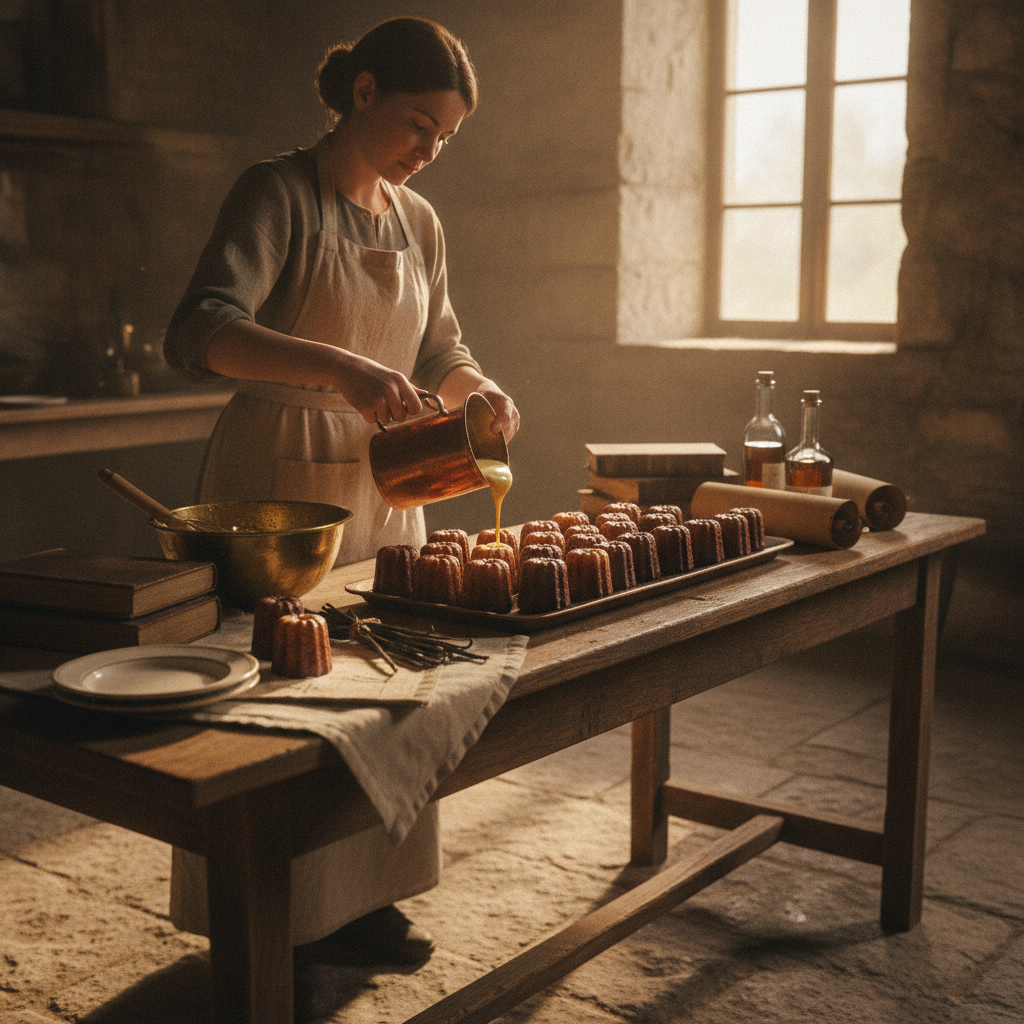
The preparation of Canelé may seem simple at first glance, but the hidden dedication and delicate technique determine its perfect taste. Traditional Canelé is made with humble ingredients: premium vanilla beans, rum, fresh egg yolks, milk, flour, and sugar. One of the most crucial steps is the maturation of the batter. First, milk and vanilla beans are simmered together to infuse the vanilla flavor, then cooled. Flour and sugar are mixed, then egg yolks are added and gently combined to create the batter. Rum is added at this stage to impart Canelé's distinctive aroma. Care must be taken not to overmix the batter. This batter is then refrigerated for at least 24 to 48 hours for cold maturation. This maturation process is essential for the ingredients to meld together, developing a deep flavor, and stabilizing the batter's consistency to create the perfect crispy exterior and moist interior when baked. For baking, traditionally, tinned copper molds called 'canelé molds' are used. These copper molds have excellent thermal conductivity, playing a critical role in uniformly caramelizing the exterior of the Canelé. After lightly coating the molds with butter or beeswax, the batter is filled to about 80%, and a dual baking method is used: baking briefly at high temperature, then lowering the temperature to slowly cook the interior. In the initial high-temperature stage, the exterior quickly caramelizes, forming a crispy crust, and then, as it slowly bakes at a lower temperature, the interior remains soft and moist. Without this delicate temperature control and skilled technique, it is difficult to create a perfect Canelé. Baked Canelés are best enjoyed immediately after being removed from the mold, while still hot. A freshly baked Canelé has a dark brown caramel coating on the outside and a creamy soft yellow interior, with the harmonious aroma of vanilla and rum. This entire process is more than just a recipe; it is like a work of art created by time, dedication, and the hands of a craftsman.
Food Story and How to Eat
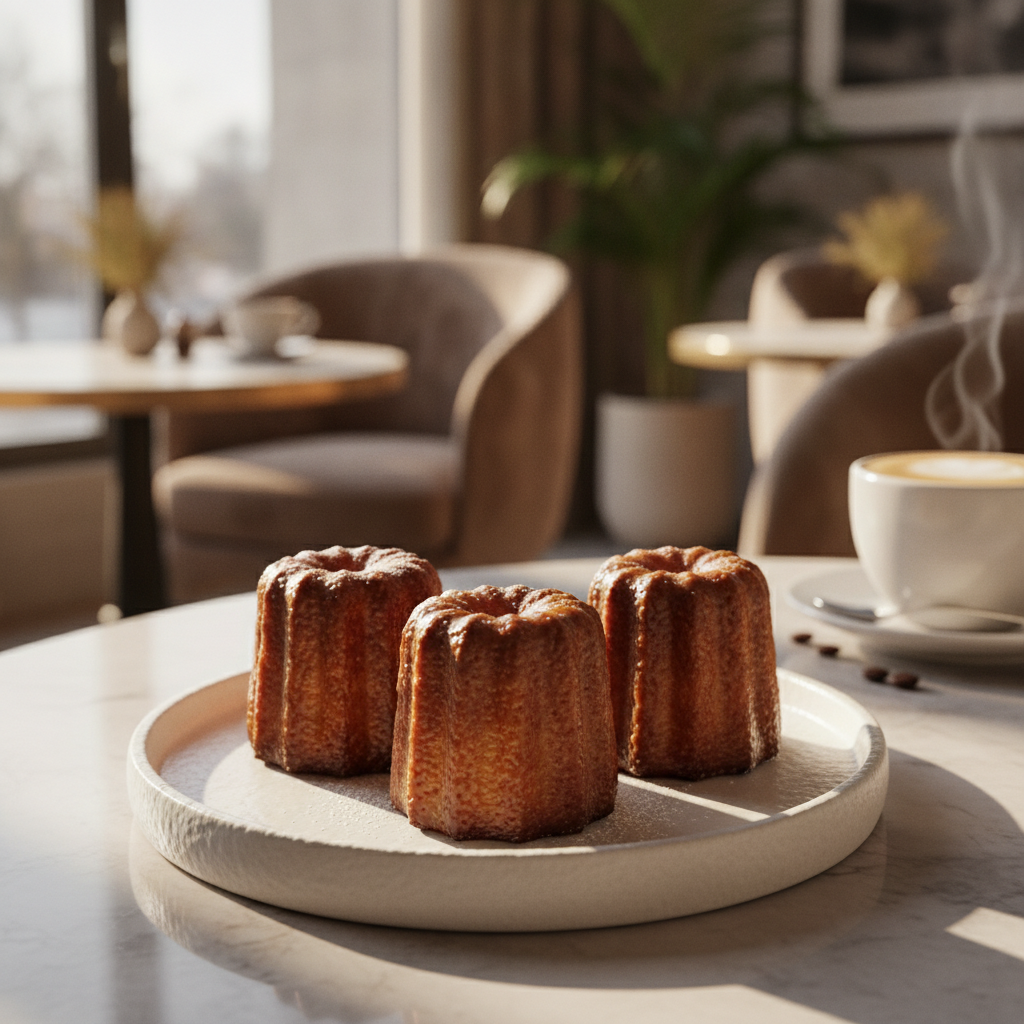
Canelé itself offers a complete gastronomic experience. However, its charm can unfold even more diversely depending on how you enjoy it. The best way to savor Canelé is undoubtedly to taste it 'freshly baked.' A Canelé just out of the oven boasts a delightful crispness from its caramel coating, and its warm, moist interior brings out the vanilla and rum aromas to their peak. Taking a bite of a freshly baked Canelé, a sweet aroma fills your mouth, bringing a wave of happiness. The stark contrast in texture between the exterior and interior is Canelé's unique charm. While Canelé is perfect as a dessert for special occasions, I recommend enjoying it as a small everyday luxury. On a weekend afternoon, a Canelé with a cup of coffee by a sunlit window offers a more precious moment of relaxation than any lavish feast. For accompanying beverages, a strong, aromatic Americano or a smooth latte works wonderfully. The slightly bitter taste of coffee perfectly complements the sweetness of Canelé and cleanses the palate. It also pairs very well with black tea; especially fragrant black teas like Earl Grey or Darjeeling enhance the vanilla notes of Canelé. If you desire a calm and elegant tea time, black tea is highly recommended. The way to enjoy it also varies with the seasons. On a warm spring day, enjoy it as a picnic dessert outdoors with a refreshing iced Americano. In summer, a chilled Canelé served alongside soft vanilla ice cream becomes an even cooler and sweeter summer treat. In autumn, enjoy it with a warm latte in a cozy atmosphere, and in winter, with rich hot chocolate or warm Glühwein (mulled wine) for a sweet warmth that melts away the cold. While Canelé is excellent on its own, it can sometimes be garnished with fresh fruit or whipped cream to create an even richer dessert. However, I personally prefer to fully appreciate the inherent taste and texture of Canelé. The comfort and happiness that this small dessert provides shine brighter than any elaborate decoration. Canelé is a dessert whose true value can only be appreciated by taking your time, slowly and fully savoring it. In your busy daily life, take a moment